Showing posts with label gymnastics for kids. Show all posts

Tuesday, May 30, 2017

Stop Procrastinating And Start Getting Fit!


When it comes into the topic of keeping ourselves healthy, what we have to say is: enough with procrastination and just start exercising! The lifelong health benefits of physical fitness are too great to be disregarded, we believe.

Feel younger, live longer. It’s not a slogan, but rather the actual health benefits one can get from physical exercise. According to a recent study published in the Journal of the American Medical Association, people who engage in moderate to intense physical exercise on a daily basis are at lower risks of suffering from certain types of diseases.


Physical Fitness: Is Exercise Really Good for You?

Ready for some good news? According to some research, regularly participating in physical exercise promotes better sleep, helps in maintaining a healthy weight, minimizes the risk of high blood pressure, stroke, type 2 diabetes, and even helps fight off depression.

“One study found that when breast cancer survivors engaged in exercise, there were marked improvements in physical activity, strength, maintaining weight, and social well-being,” said Rachel Permuth-Levine, PhD, deputy director for the Office of Strategic and Innovative Programs at the National Heart, Lung, and Blood Institute of the National Institutes of Health.

“Another study looked at patients with stable heart failure and determined that exercise relieves symptoms, improves quality of life, reduces hospitalization, and in some cases, reduces the risk of death,” Dr. Permuth-Levine added. She cleared out that physical exercise isn’t only beneficial for people with good health conditions. “If we can see benefits of moderate exercise in people who are recovering from a disease, we might see even greater benefits in those of us who are generally well.”

Physical exercise doesn’t have to be strenuous in order to bring positive results. Even just by taking part regularly in a moderate exercise (walking, jogging, running on the treadmill, etc.), can already produce positive and healthy results.


Making Physical Exercise a Lifelong Habit

The most common reason why most people don’t exercise is because they don’t have enough time to do so. If you find it hard to add regular exercise to your daily schedule, keep in mind that even just short bouts of physical exercise in your free time could bring numerous health benefits such as minimizing the risk for cardiovascular disease. Aim for at least 10 minutes of short and light exercise every day to maintain a healthy lifestyle.

If you have lived a sedentary lifestyle for too long, then you might find adding physical exercise to your daily routine to be an overwhelming task. What you could do is try to gradually shift to a more active lifestyle, so you won’t be too overwhelmed with the transition.

For example, instead of using the elevator to go upstairs, you could try and take the stairs instead. Also, instead of driving to a nearby grocery, you could go and take a walk as an alternative. The key to physical fitness is to start gradually and get yourself prepared. “Have your shoes, pedometer, and music ready so you don’t have any excuses.” Rachel Permuth-Levine said.

Learn more about health and fitness by visiting and reading our educational blogs. Live a healthier and more active lifestyle, enroll today at Bianka Panova Sport and Art Academy and learn gymnastics for kids with us.

Tuesday, April 11, 2017

Germany, Ukraine: World Cup Series For Artistic Gymnastics Titleholders

The final leg of the FIG World Cup has concluded in the O2 Arena of London last weekend, finally crowning the champions of the series. Hailed master of the sport for the men’s division is Ukraine’s best and Olympian Oleg Verniaiev. For the women’s division, Tabea Alt was the queen. Both athletes have successfully brought the 2017 All-around World Cup Series in Artistic Gymnastics title to their home country.

Verniaiev has been successful since last summer’s Olympics, but he didn’t let this get in his head. At this year’s World Cup Series, he went on to win a silver at the AT&T American Cup and gold medals from the DTB-Pokal World Cup in Stuttgart and finally in London. Because of this, he has assured Ukraine would win on the men’s side.

His performances on rings and vault awarded him with gold medals, while on the floor exercise and parallel bars he only got silver medals. He wasn’t as strong at the high bar, where he placed sixth, and on the pommel horse where he was fourth.

At the All-around, close on Verniaiev’s heels was USA’s super tumbler Donnel Whittenburg who had the highest score of the day on floor exercise and the second best on rings and vault. 2016 Olympic team finalist from Germany, Lukas Dauser, was third as he had the highest score of the men’s competition on parallel bars and impressed on horizontal bar, pummeling him up to the third spot.


For the women’s competition, Tabea Alt showed she wasn’t contented with her win on the Stuttgart as she dominated the sport once again in London. She was gold on uneven bars and floor exercise. On beam and vault, she was second as she allowed Spain’s Ana Perez and Great Britain’s Amy Tinkler to take the gold on the respective apparatus. Despite this, Alt still finished as the All-Around champion.

“It's always good to be stable and have good routines, so that's the goal for success,” Alt said after the competition even though she wasn’t expecting to win. "I am speechless. It is incredible that I am now standing here with the FIG Cup in my hands and the medal around my neck."

Alt’s victories, added with compatriot Kim Bui’s fourth-place finish at the American Cup, made it possible for the Germans to win the women’s title.

USA’s Viktoria Nguyen, a replacement for Ragan Smith, was third on uneven bars, beam and floor. She was also fourth on vault, making her the silver medalist in the All-Around. Behind her was Tinkler who was recorded to admit that she had calf problems this year so she wasn’t expecting to win either. 

The top three winners in the All-Around World Cup standings all took home, aside from the medals and trophy, the cash prize of between 15,000-25,000 Swiss Francs.

Keep up with the latest news and updates about the sport of gymnastics by following our official blogs and social media sites. Enroll today at Bianka Panova Sport and Art Academy and learn gymnastics for kids with us! Come and experience world class training and education!

Thursday, March 30, 2017

Why Gymnastics Is Good For Kids’ Academics


Did you know that children’s weight and physical activity levels can affect their thinking and learning skills?

Researchers gathered 45 children aged 7 to 11 with normal weight. 24 children were physically active while 21 of them were not. Those children who are active are part of sports like gymnastics, swimming, soccer, or dance, which they do for more than an hour in 1 week.


The study also gathered children who are overweight and inactive.

As it normally is, kids with normal weight and who are active had less body fat, and a lower resting heart rate compared to inactive and overweight children.

However, the researchers also observed that children with normal weight and who are physically active did better on mental skill test in comparison to those who are inactive. The test includes planning and paying attention.

On the other hand, as the study found an association between physical activities and mental skills in children, it did not find a cause-and-effect relationship.

According Medical College of Georgia health psychologist Catherine Davis, “Activity made a difference even among normal-weight kids. That verifies that physical activity makes a difference in brain function. If they can cut some of the empty calories out of their diet and pick up the pace on physical activity, they may grow into their weight.”


Catherine Davis also stated that the study focused on weight, but would probably be more accurate to look at the amount of body fat in children. In the study, overweight kids had more fat that weighing more because of extra muscle mass.

Others suggest that future studies should also include children who are overweight but physically active, just to see if their mental skills also benefit from physical activity, also to learn more about how kids’ brain health are affected by their weight and exercise activities.


The Exercise-Effect on Academics


Sports and physical activity are generally linked with positive effects on children’s physical health. It is believed that a regular participation in physical activity is associated to enhancement of brain function and cognition, which positively affects academic performance.

Yes, exercise is good for cognition and here are some reasons why:

  • Increased blood and oxygen flow to the brain
  • Extended levels of norepinephrine and endorphins reduce stress and improves mood
  • Increased growth factors can help make new nerve cells and support synaptic plasticity
Those are just some of the reasons why exercise benefits children’s academic skills. The rising pressures to improve academic scores which often lead to instructional time for subjects, including mathematics and language, at the cost of time for being physically active.

Exercise is one of the biggest factors children need, but unfortunately, most kids are not exercised enough. If you still do not consider exercising important for your child, here are some reasons why you should:

1. Physical activities reduce the risk of diabetes and pre-diabetes

2. Being physically active improves immune system function

3. Physical activities improve children’s sleep and mood

4. Sports help children’s bones become stronger

5. Sports can decrease restlessness or hyperactivity

6. Being physically active reduces ADHD symptoms

7. Physical activities balance weight


As stated by University of Chicago Psychology Professor Sian Beilock, “We show that non-language related activities, such as playing or watching a sport, enhance one’s ability to understand language about their sport precisely because brain areas normally used to act become highly involved in language understanding. Sports Experience Enhances the Neural Processing of Action Language.”

“Experience playing and watching sports has enduring effects on language understanding by changing the neural networks that support comprehension to incorporate areas active in performing sports skills,” Professor Beilock added.

In conclusion, regular physical activities or sports are essential for children’s needs. Not just to improve their body appearance, but also to improve their mental skills and critical thinking.

Gymnastics also does a great job for helping your kids boost their physical activities, so if you’re looking for a school that can give your child the best training experience, you could try and check Bianka Panova Sport and Art Academy. With our state-of-the-art training facility, fun and exciting training sessions, and extensive knowledge and experience of our head coach — Bianka Panova, we can ensure that your child will receive the highest quality of training and education. Enroll now and learn gymnastics for kids with us!

Friday, March 24, 2017

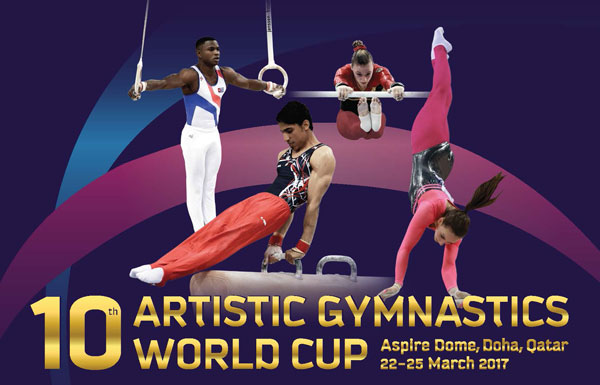
10th Doha World Cup Finalists, Ready For The Last Match

The 10th Artistic Gymnastics World Cup has taken off in Aspire Dome, Doha, Qatar on March 22 and is scheduled to last until the 25th. The qualifying round has been done and a lot of the big names have made it into the finals. Of course, the newcomers also showcased their talents and some of them have made it into the finals as well.

So far, one of the many promising athletes in the competition was China’s Liu Tingting who appeared to be in top form. She qualified for the finals by being the second on uneven bars but the top in women’s floor exercise and balance beam. Tingting missed last year’s Rio Olympics due to injuries, but the 15-year-old did amazingly well at the Melbourne leg last month, and she was determined to continue her good record into Doha World Cup.

Close on Tingting’s heels in what seemed to be at almost all of the events is Australia’s Emily Little, who participated at the 2012 London Games. Little took her share of gold, silver and bronze from the Melbourne World Cup like Tingting and she was recorded to be saying that, “It’s always an honour to represent my country. I look forward to pick up some medals in Doha.”


So far, Little has qualified into the finals by being second in floor exercise and third in women’s vault and balance beam. Who went ahead of her to take the second spot on the balance beam to qualify for the finals was 2004 Olympic Champion from Romania, Catalina Ponor. Three days before the Doha event, Ponor has bagged two gold medals at the World Cup in Baku, Azerbaijan. “I hope to maintain the good show in Doha,” Ponor said.

Another one of the big names in this event was Uzbek veteran Oksana Chusovitina, who also squeezed into the finals by being second on women’s vault, behind China’s Wang Yan who was a bronze medalist in the 2016 Olympic Games. There are doubts if Yan can still compete for the finals, as she injured herself in one of her tumbling passes on the floor exercise during the qualifications.

Elsewhere, the men’s artistic gymnastics competition was led by Hungary’s 2012 London Olympics gold medalist Krisztian Berki, who qualified for the finals by dominating once again the pommel horse. Next to him was China’s Zou Jingyuan and Croatia’s Ude Filip respectively. Jingyuan was also first in parallel bars, followed by Switzerland’s Pablo Brägger and Turkey’s Ferhat Arican

The Australian team managed to get in male representatives as Christopher Remkes qualified by being third in men’s vault while teammate Clay Mason Stephens was on sixth. Compatriot Mitchell Morgans was also second on high bar.

For a complete list of finalists, visit FIG’s twitter account.

Be the first to know the winners of the 10th Doha World Cup by following our official blogs and social media sites. Enroll today at Bianka Panova Sport and Art Academy and learn gymnastics for kids with us! Come and experience world class training and education!

Tuesday, March 21, 2017

AGF Trophy 2017 Concludes In Baku

After the qualifications last weekdays, the FIG Individual Apparatus World Cup called AGF Trophy or World Cup in Baku concluded over the weekend in its host country, Azerbaijan.

This is not the first time Baku has hosted huge gymnastics competitions for FIG, and this time a lot of Olympians have emerged victors in their respective apparatus signature. To start off, probably the oldest in the event and the one with the most experience under her belt—a record SEVEN Olympic Games!—was 41-year-old Oksana Chusovitina from Uzbekistan who didn’t show any signs of slowing down.


In the qualifications and finals, the 1992 Olympic team gold medalist dominated the vault with an astounding performance, and this is done without even attempting the very difficult Produnova vault that she tried in last summer’s Rio. Second to Chusovitina on vault was Australia’s pride, another Olympian Emily Little, followed by the bronze medalist from Slovenia, Teja Belak.

Another experienced competitor was five-time Olympic medalist, Romania’s Catalina Ponor. Albeit leaving Rio without any shiny remembrance, the 29-year-old blasted her competitions on balance beam and floor in both the qualifications and finals without much struggles in this competition. She has boasted her skills in AGF Trophy as a preparation for the European Championships next month, which is going to be held in Romania after sixty years.

Silver and bronze on balance beam was Vasiliki Millousi of Greece and AUS’ Little respectively, whilst on the floor Little once again stole the silver, leaving the host country’s representative Marina Nekrasova with the bronze.

Amidst all these experienced artistic gymnasts, a newcomer has emerged victor as well. Ukraine’s Diana Varinska, a first-year senior in her first World Cup competition, bagged the gold in uneven bars by showing her lovely forms, giving life to the wonders that maybe Ukraine is going to rise in women’s gymnastics once again. Varinska left the silver and bronze to the two Australians, Rianna Mizzen and Georgia-Rose Brown respectively.


Men’s Finals Results


Of course, if the women’s division showed great strength, the men’s division leveled that as well. On the lead was, dubbed “Lord of the Rings” after proving to be the best in the apparatus all around the world in 2015, Greece’s Eleftherios Petrounias who clinched the gold once again in his signature event. He is also aiming for the European Championships next month.


Petrounias’ win on the rings left the challengers from Japan (Kazuyuki Takeda) and Ukraine (Yevgen Yudenkov) with the silver and bronze respectively.

However, not all Olympians had the same fate as Petrounias. Although he was the 2012 Olympic champion, Hungary’s Krisztian Berki was defeated on the pommel horse as China’s Weng Hao bagged the gold, leaving him for silver. On the third was Croatia’s Filip Ude.

Hao’s teammates, Rongbing Liu and Youxiao He also took home the gold and silver respectively on the parallel bars, leaving Japan’s Shogo Nonomura for the bronze, showing that maybe China could win once again versus the Japanese on the Tokyo 2020 Games.

Elsewhere, another Japanese clinched gold at the horizontal bar, Naoto Hayasaka. He was followed by Anton Kovacevic from Croatia and Tomas Kuzmickas from Lithuania. At the vault, AUS’ Christopher Remkes finally got his gold after falling on the second in front of his home crowd in Melbourne last month. Belarusian Pavel Bulauski and France’s Zachari Hrimeche took the silver and the bronze respectively. Kuzmickas, who joined three event finals, was awarded once again by gold this time on the floor exercise, leaving Bulauski and Hayasaka on the remaining two spots.

Keep up with the latest news and updates about the sport of gymnastics by following our official blogs and social media sites. Enroll today at Bianka Panova Sport and Art Academy and learn gymnastics for kids with us! Come and experience world class training and education!

Tuesday, March 14, 2017

Victoria Filanovsky, Baltic Hoop All-Around Champion

Israel’s Victoria Filanovsky twirled her way to the highest top of the All-Around podium on the Baltic Hoop International Rhythmic Gymnastics Tournament held in Riga, Latvia on March 11 to 13, 2017.

Despite placing 10th in the All-around competition of the recently concluded 2017 Grand Prix Moscow, Filanovsky has now become the champion in All-Around this time with a score of 17.500 on hoop, 18.550 on ball, 17.600 on clubs and 14.900 on ribbon events, accumulating to a total score of 68.550. Her total is an astounding five point away from the silver medalist from Belarus, Yuljya Isachanka, who has 63.350. Bronze medalist Julia Evchik, from Belarus as well, was behind with a 62.200 point.


For the individual apparatus competition, Filanovsky only won the gold on ribbons while Belarusians Evchik and Isachanka led on hoop and ball respectively. Finally, Estonia’s Olga Bogdanova snatched the gold on clubs.

The host country, Latvia’s team led in the All-around with their five hoops, three balls and 3 ropes. They are also the hot ticket at the Ludmila Kachkalda Memorial Cup, a concurrently held group competition which is named after Latvia’s most famous rhythmic gymnast. Second to them was Finlad’s team and on the third was team Poland.

Baltic Hoop is one of the international events approved by International Gymnastics Federation (FIG) for this year and it doesn’t just surround the Baltic Sea as it has already reached other countries all around the world. This is the first greatest event for many young gymnasts in Latvia.

For a full list of results, click here.

Keep up with the latest news and updates about the sport of gymnastics by following our official blogs and social media sites. Enroll today at Bianka Panova Sport and Art Academy and learn gymnastics for kids with us! Come and experience world class training and education!

Tuesday, February 28, 2017

Mamun Clears The Clouds Surrounding Her Rumored Retirement

During the previous weeks, people have been speculating that Margarita “Rita” Mamun has retired from being a rhythmic gymnast. A lot of the fans are sad because they believe this is her most glorious time yet, after she has won the gold in the Rio Olympics All-around Championship. Russian Rhythmic Gymnastics Federation President Irina Viner-Usmanova’s statement didn’t help at all in the cloud that is surrounding Mamun’s real state on the sport. The President said in an interview that Mamun has not trained for a while and she doesn’t expect her to come back.

To clear all these confusions, Mamun has finally spoken. In an interview with a Russian paper, Sport-Express, Mamun talked about her life after the 2016 Olympics, her relationship with swimmer Alexander Sukhorukov, and what her future plans are. The interview is in Russian and we tried our best to translate it so everyone can have an idea of what Mamun’s statements are.


The first question was, of course, the situation with her career. Mamun answered this by saying that she was merely in a hiatus due to back aches. It needed to be fully rehabilitated before she could go back to rhythmic gymnastics. She clarified that she’s still in the team and she did not go. As a matter of fact, she hopes to come back and perform once again. However, Mamun also said that if she would retire or not, all depends on her health. The decision would be announced later if she would fully recover or not.

When asked about her life after the Olympics, Mamun expressed her feelings about the public functions or galas she was invited to. She believed it was not for her, as she is not the kind of person who quickly makes new friends and immediately feels comfortable with strangers. Not surprisingly, she has already been invited to one of the dance shows, but she refused as her back wouldn’t allow her to dance. Although, she believes she has some dancing stuff she need to learn, teach girls in Novogorske, or open a gymnastics school.

Mamun wasn’t sure about coaching, and said it was still all guesswork. If there is something she would love to do after retiring, it was to enroll in an art class. She has this favorite hobby, which is painting, and she would love to put more time into that hobby of hers. She was looking into maybe even designing.

Mamun and Sukhorukov were engaged on December and the rhythmic gymnast said she answered yes without any hesitation. Their relationship has struggled during the last Olympic cycle as training forced them apart. But they succeeded in that obstacle and after everything, they vacationed in Dubai. Right now the date is still not chosen, but the wedding would be in the summer.

Keep up with the latest news and updates about the sport of gymnastics by following our official blogs and social media sites. Enroll today at Bianka Panova Sport and Art Academy and learn gymnastics for kids with us! Come and experience world class training and education!

Tuesday, February 14, 2017

How To Safely Practice Gymnastics At Home

Gymnastics is a kind of sport that requires the following qualities: strength, flexibility and focus. To be a great gymnast, one must be dedicated to do their workouts and training on a daily basis for them to develop the physical qualities they need to perform better.

As parents of gymnasts or athletes, if we know that our kids really love their sport and are working hard on being successful at it, we also know that sometimes they forget about it. There are days when they want to stay home because they are lazy for some reasons, or that one of their friends in the sport is not going to train on that certain day and they don’t want to train alone, or they are just uncomfortable in the gym. There would always be a time when they don’t want to leave the house, and it is our job to make sure they are not slacking in their efforts to reach their dreams.


If they don’t want to leave the house, they might prefer to do their workouts at home. Luckily, there are some exercises that they will be able to practice at home which are safe and simple. Some of these exercises require sport equipment, but some of the trainings can be performed at home without the need to travel to a gym.

Listed below are some of the things we have to prepare in order for our kids to safely practice their gymnastics skills at home. Before beginning anything, we should keep in mind that before our kids performs any kind of workouts by themselves, they should seek the guidance of a fitness professional or their coach.

  • As the head of the house, we should make sure that our house has enough room for our kids to perform a gymnastics workout. Find a room that has enough space and clean it up to make sure that no obstacle can hinder the exercises that they will be performing.
  • We must find a high-quality gymnastics mat and put it on the floor on the space where we want our kids to perform their workouts.
  • We have to make sure that our kids are wearing comfortable clothes, preferably a loose-fitting one so that it won’t restrict their movements and they will be able to move freely.
  • Before doing any kind of workouts, we should make sure that our kids do a series of warm-up exercises such as jogging or walking. Working out while their muscles are cold can cause injury so they have to always remember that they include a set of warm-up exercises in their daily workout.
  • Aside from warm-up exercises, our kids have to perform stretching exercises as well to increase their flexibility and range of motion. Also, by stretching their muscles, they can reduce the possibility of a muscle strain, a thing that can hinder their workouts, even for a long term.

Although exercises can be done at home, our kids should be careful especially when performing intense workouts, as improper technique can cause injury. When performing their exercises at home, they can use educational videos and instruction manuals as their guide. We should also accompany our kids to a visit to their local gym every once in a while so that the instructor can correct their technique.

It is advised, however, that for a younger child it would be a safer bet if you would send him/her to a school that teaches gymnastics for kids. You could check and visit Bianka Panova Academy at 2 Bukit Merah Central, Singapore 159835 to see if we are the appropriate training ground for your child!

Thursday, February 2, 2017

Does Exercise Help With Studying?

As a Dutch review of previous studies suggests, being physically active can have a positive effect on the child’s academic performance. The review examined 14 studies which include more than 12,000 children. According to those studies, engaging in physical exercise may help increase blood and oxygen flow to the brain, boosting the cognitive function of the children.

Writing in Archives of Pediatrics & Adolescent Medicine, researchers stated that they discovered strong evidence of a relation between physical activity and academic performance.


However, according to VU University Medical Center in Amsterdam, the authors of the said research, they stated that more accurate and reliable measurement instruments were required to examine the link in greater detail.

Dr. Amika Singh and colleagues were triggered to observe the connection between exercise and the child’s performance in the classroom due to concerns that the pressure to improve the grades and performance of the students could result into more time being spent in the classroom and very limited time to perform physical exercise.

So the authors identified ten observational and four interventional studies for review. Twelve of the mentioned studies were done in the U.S., one in Canada and one in South Africa. The sample sizes of the studies varied between fifty-three to twelve thousand subjects between the ages of six to eighteen years old, the period of follow-up ranges from eight weeks to more than five years.

As the study suggests, two of the reviewed researches were evaluated as being of high quality.

Blood flow

According to the researchers, they noticed a clear proof of a “significant positive relationship” between exercise and academic performance using those two studies as evidences.

The study suggests that the reason behind it is that exercise is responsible for increasing the blood and oxygen flow to the brain. The improvement in the blood and oxygen flow positively affects the cognitive functions of the brain. However, according to the researchers, more studies were needed to investigate the exact connection between physical activity and academic performance.

Participating in any kind of physical activity also helps in stress management, mood regulation, and it can also alleviate anxiety, helping children behave better in the classroom.


According to Dr Singh, “children who learn to participate in sport also learn to obey rules. This may mean they are more disciplined and able to concentrate better during lessons.”

“People always ask, ‘How much exercise do I need to do to get an A?’ We don’t know that, but we would like to find out,” said Dr. Singh. “Children should be active for at least one hour a day, for health reasons. But we also need to look at other things, like what kind of activities they should do, when they should do them and for how long.”

None of the studies used an objective measure of physical activity. Most of the studies instructed the subjects or their parents to write down how much physical activity they were getting.

More health and fitness related articles can be read by visiting our official blog sites. Experience a fun and exciting gymnastics education, come and join us at Bianka Panova Sport and Art Academy today!

Friday, January 20, 2017

Exercises To Prevent Injuries To The Wrist

In most sports, especially gymnastics, the wrist is forced to hold an overwhelming amount of weight, and is exposed to huge amount of trauma by performing different activities that exceed normal daily activity. 


While doing a tumbling or a handstand, the wrist of a gymnast is often required to hold his own bodyweight while bending his wrist backwards. Also, most of the movements done by the gymnast require fast and sudden movements that may stress their wrists and hands too much.

Daily exposure to this kind of stress may cause fractures, sprains and dislocations to the wrist of an individual. Luckily, there are several exercises that you can perform to avoid to protect your wrist for these kinds of injuries.


1. Wrist Extensor Stretch

Extend your hands with your palm facing up and elbows straight. Using your other hand, pull your extended hand downwards. You would feel a mild to moderate stretch in your wrist while doing this. Hold this position for 10-15 seconds and then repeat using your other hand. Do it for three sets.


2. Wrist Flexor Stretch

Stretch your hands by keeping your elbow straight and then pull your wrist backwards using your other hand. During the exercise, you should feel a mild to moderate stretch. Hold this position for 10-15 seconds before repeating with your other hand. Repeat for three sets.


3. Resistance Band Wrist Flexion

Using a resistance band, wrap the band around your hand while your palm is facing up. Put your elbow by your side and keep your elbow bent at a 90-degree angle before slowly curling your wrist up, just like doing a dumbbell curls. Do it for 15 repetitions before repeating on your other wrist.


4. Resistant Band Wrist Extension

Wrap the resistance band around your hand with your palm facing down. Keep your elbows at your side and keep it bent to 90 degrees and curl your wrist up slowly, just like doing a reverse dumbbell curls. Perform 10-15 repetitions before repeating on your other wrist.


5. Tennis Ball Squeeze

Grab a tennis ball and squeeze it as hard as you can without hurting yourself. Do it for 5-10 seconds and repeat 8-10 times.


It is very important to take care of your wrists as it serves a lot of function for you as a gymnast, and as an individual. However, keep in mind that these exercises are meant for preventative measures only and are in no way to be used to cure existing injuries. If you are already injured, you should consult your physician and you should not just rely on information found on the internet.

If you are looking for a great and reliable school that teaches gymnastics for kids you could check and visit the official website of Bianka Panova Academy.

Friday, January 13, 2017

Flexibility Exercises For RG

Flexibility is by far the most important and focused aspect of the sport of rhythmic gymnastics, while some other aspects like core strength is just secondary. This is important because the routines require great flexibility of the gymnasts to bring the music to life through their bodies—so important that stretching and flexibility takes up most of the warm up routine.

While stretching the body to its extremes is necessary for success, a rhythmic gymnast needs to make sure that they are performing this task without causing any injuries. While stretching, she should listen to what her body is telling her because there are two types of pain: good and bad. A good pain is described as the uncomfortable feeling of the muscles being stretched and although the gymnast is uncomfortable, she should still be able to control her breathing and remain somewhat relaxed. On the other hand, a bad pain is described as the feeling of muscles being pushed too far, the feeling of something dislocating, pulling, or being in so much pain that she starts tearing up and breathing abnormally.

Sadly, some gymnasts who want to increase their flexibility endure through the bad pain just to have immediate results. What they need to remember is that this is a slow process and needs to be taken with caution.

Many coaches and gymnasts have different approaches to achieving their desired level of flexibility, but here we have gathered some exercises to help someone out there get started with their flexibility foals.


1. Butterfly Stretch

This is probably the most famous and most basic kind of stretch for someone who’s just beginning their flexibility exercises. Although even when a gymnast is already in an advanced level, they still do this.

The butterfly stretch is done while sitting down on the floor. Starting position is sitting with your feet stretched in front of you, flat against the ground. Now pull your legs together, with your knees to the sides, until your soles connect. Now pull your heels as close to your groin as possible. In the beginning of course you can only pull your heels in for a little distance, but as you continue doing this for weeks, eventually your heels would connect to your groin.

After you’ve pulled it as close as you are comfortable, start gently bouncing your knees up and down to loosen the muscles. Do this for about 10 seconds, then use your elbows to gently press your knees toward the ground for another 10 seconds. After a while you’ll notice that your flexibility has improved because it has become easy to press your knees to the ground.

2. Swan Stretch

This exercise is commonly seen in the gym. You can do this like how gymnasts do it by lying face down on the floor with both hands in front of your shoulders, fingers facing forward, like how you would start a push-up. You should then press into your hands to lift your belly off the floor. While keeping your abs tight, shoulders down and pelvis grounded, lengthen your upper body away from the floor, reaching out and up from crown of the head. Pull your shoulder blades together, at the same time opening the chest, and then hold it for 30 to 45 seconds. Release and then repeat.

3. Ceiling And Toe Touch

This exercise is what its name suggests. While sitting on the floor, extend both arms over the head, fingers pointing to the ceiling, for as far as you are comfortable. Then, stretch your left arm towards the ceiling for 10 seconds. Relax it and then do the same with the other arm.

Once those are done for a couple of reps, lower your arms in front of you. Bend your waist and reach for your toes. Do this for 10 to 15 seconds too.

This exercise can be done while standing up as well, but sitting down is better as it lessens the weight in the lower back.


4. Over-splits

Before doing this particular stretching, it is important to remember that this is only done by gymnasts who has some degree of flexibility already and not for beginners as this is really hard and dangerous if not done right.

Over-splits is what it is called when a regular leg split went over 180 degrees angle. You can do this by putting one foot on an elevated object like a chair or table while the other leg is stretched directly behind you. This position is held for 2 to 3 minutes.

It is important to keep in mind that while in this split position, the torso should be up and hovering above the ground. If your pelvis is touching the ground, then you need to increase the height of the object her elevated leg is resting on. Conversely, a coach or team mate can help increase flexibility by carefully pushing your pelvis towards the floor.

Read more about health and fitness by following our official blogs and social media sites. Enroll today at the best sports academy to learn gymnastics in Singapore -- Bianka Panova Sport and Art Academy -- and experience the highest quality of gymnastics training and education! :)

Tuesday, January 3, 2017

3 Things To Look For In A Nutrition Label


As parents of gymnasts, we prepare their meals most of the time so it is important that we know the proper nutrition for young gymnasts and how to properly check if a food is good for our kids or not. This is why we prepared a list of three things to look for in a nutritional label. 

Reading nutrition labels, or nutritional facts, are not only good for ourselves, but especially when cooking for other people like our young athletes. If our children are gluten free, we need to make sure that we cook something that doesn’t have any gluten in it. If our child’s diet doesn’t include a lot of carbs for a day, we need to be able to properly compute how many carbs there are on a food that we cooked. 

Nutritional labels of different food products aren’t exactly all the same, but reading a regular nutrition label can still help. As long as we know what we are looking for, we should be able to decode any kind of nutrition labels. So here we have prepared pointers on what we all need to know about reading nutrition labels. 

Serving Numbers and Serving Sizes 

When it comes to the number of servings and serving sizes, it is important to remember that nutritional facts are mostly based on one serving only. Always check the serving size to know how many servings we are going to take from a certain product, or how many servings we are letting our kids to eat. This means that the bigger the serving, the higher the calories. 

Take a bag of chips, for example. Usually at the top of the label, it is indicated how many chips make up a single serving. From there, we can identify how much sodium our children are going to eat from a serving size of eleven chips, for example. And as athletes who follow a strict diet, their intakes of salt should be very limited. 

On instances that we are comparing nutrients and calories between two different food brands, always check the serving size to ensure that they are based on the same measurement. 

Calories from Fat 

The “Calories” label under “Amount per Serving” is where we can see the number of calories the product has per serving. We will also see the amount of calories from fat here. 

Take note that even if something is fat-free, it doesn't mean that it's also free from calories. Even if a product is low-fat, it may have the same amount of calories as other products have, so we should always check the number of calories in the label. 

One thing to keep in mind is that just because something has a lot of calories, it doesn’t mean that our children are eating badly. We should look out more on how many of those calories come from fat. If a lot of the calories are from fat, then it’s good to steer clear of that product. Or, we could look if another brand has that product with less calories from fat. Then, we’ll still be able to get the food our young athlete wants and it will be a lot better for them. 


What is the %DV 

A lot of people doesn’t know what this means, but if you have been in charge for your child’s diet for a while, you might be familiar with it. %DV or the percentage of Dietary Value that each nutrient gives is essential for us to know how much of each nutrient we should allow our kids to consume daily to attain the health he needs for his sport. This is also a great way to find out if our children are not consuming enough of any particular nutrient. We need to make sure that we record all the %DV that our kids consumed each day. If any nutrients go over 100, then we’ll know he’s consuming more than he needs to. We should try to keep it as close to one hundred as possible. 

These are just three things to look for in a nutritional label, to read more and get updated on all important health information, follow the posts on our Facebook Page. Looking for a fun and exciting way to learn gymnastics? Then come and enroll at Bianka Panova Sport and Art Academy today :) Come and learn gymnastics for kids with us!

Wednesday, December 7, 2016

Familiarizing the Rhythmic Gymnastics Events

As a parent who is new to gymnastics and wants to learn more of it, maybe because you are thinking about letting your kid join the sport, you probably have some misunderstanding of it. Most people think of artistic gymnastics when they hear the word “gymnastics.” This is not entirely wrong, but there is also another kind, which is rhythmic gymnastics. In this article, we are going to help and make you knowledgeable in this unique sport.

In rhythmic gymnastics, there are five pieces of equipment. These set of equipment are also called “events” because they are performed one at a time. One performance cannot use two or more equipment. Every two years, the International Gymnastics Federation (FIG), who is the governing body for Gymnastics worldwide, designates four of the apparatus to be used, and the other to be set aside for two years.

Before explaining what these events are, let us first get familiar with the floor.


The Floor

Accompanied by music from 75 to 90 seconds, every single rhythmic event is performed on a floor mat which has a measurement of about 42.5 feet by 42.5 feet. The floor for artistic gymnastics is different from that of rhythmic gymnastics. For rhythmic, the floor doesn’t have the same amount of spring or padding compared to the artistic floor, as per the request of rhythmic gymnasts. According to most, it is much easier to perform the skills required on a floor without spring and padding.

Aside from the events, there are also exercises done on the floor and without any apparatus. This event is only on the introductory levels of competition in the United States and abroad where it is a compulsory routine. It won’t be seen at the Olympics and other international competitions.


The Events

1) Ribbon – This apparatus is a single strip made of satin or a non-starched material, about 6.5 yards long and 1.5 to 2.3 inches wide. The ribbon is attached to a stick made of wood or synthetic materials that is 19.5 to 23.4 inches long and .4 inches wide.

2) Rope – The rope is measured proportional to the height of the gymnast and is made out of hemp or synthetic material.

3) Hoop – This apparatus is made of either wood or plastic and is 31 to 35 inches in its interior diameter.

4) Clubs – The clubs has the same length, which is about 16 to 20 inches long. They are made from wood or synthetic material and should weight about 5.2 ounces each for easier handling.

5) Ball – The ball must be made from rubber or synthetic materials and should also be 7 to 7.8 inches in diameter. Neon-colored balls are not allowed and the only patterns approved on the ball are geometric patterns.

To know how these apparatuses are used, watch Bianka Panova herself perform on each here:


To read more fitness and gymnastics-related articles, visit our educational blogs. Experience a fun and imaginative gymnastics training, come and enroll today at Bianka Panova Sport and Art Academy :)

Monday, November 28, 2016

How to Get Over a Block

On a previous article, we have discussed briefly the important things we needed to know about blocks in gymnastics and the different reasons why this phenomenon happens. To refresh our knowledge, here is the article: What is a Block in Gymnastics?

Now that we know what blocks are and why it happens, it’s about time that we learn HOW to get past it. It has been mentioned that the gymnast herself who is suffering from a block doesn’t have any conscious control over it, but there are ways that could help the gymnast and here are some of them:


1. Talk to the coach

- First thing to do when one has a block is talk to her coach. Almost all gymnast encounter a mental block during her entire career, so chances are the coach have already seen this happen many other times. The gymnast should be honest about what she feels and what she is experiencing so the coach would understand. Work with the coach and create a plan about how the gymnast can get comfortable with the skill.

2. Visualize

- Once a plan has been worked out with the coach, the nest step is to visualize the skill. The gymnast should mentally imagine that she is doing the skill. The more detail, the better. She should find which part of the skill scares her the most and give emphasize on it. Repeat the part over and over again in her head. Also, she can try doing the hand and foot movements without actually performing it while her eyes are closed, still visualizing the skill.

Now on an instance that she can’t visualize herself performing the routine, she could watch a video over and over again until she could picture herself doing it.


3. Advancements

- Once the gymnast has visualized enough that she thinks she can do it even in her sleep, she should try going back to the last skill she was able to do successfully. Repeat it multiple times until she’s gained confidence that she has once again regained her footing in gymnastics. Once she’s confident enough, she should then try doing the skill that scared her. Try it while the coach spots, on stacked mats, or into a pit or resi. Keep doing the skill many times until she feels ready to increase the level of difficulty. Remove a mat one at a time or have the coach spot less and less.

4. Keep at it

- The gymnast must be patient with herself, as well as the coach with their student. She can and she will get the skill back, it’s just a matter of figuring out how to get her mind on track. She must keep working on different methods and she’ll eventually get there, just don’t give up!

Listed here are just a few ways that could help a gymnast going through a block. However, it should be kept in mind that these ways doesn’t have instantaneous results, because this is a continuous process. If it didn’t work on the first time, continue doing it a few more times.

To read more gymnastics-related articles, visit our educational blogs. Experience a fun and imaginative gymnastics training, come and enroll today at Bianka Panova Sport and Art Academy :)

Tuesday, October 18, 2016

Do You Know What Ingredients to Avoid Feeding Your Child?


A few articles in our blogs have already tackled what are the best foods you should allow your athletic kid to eat and what could help develop his muscles and reduce fat. All over the internet, there are also countless materials talking about this, but do we really know what food ingredient we should avoid?

(Also read: Nutritional Needs of Young Athletes)

All around the places there are confusing articles saying one should eat this and shouldn’t eat that. The media further confuses people as one day they are talking about the disadvantages of fats, then the next day they would say that carbs are great for the body.

Food manufacturers also add to this muddle by printing misleading labels and bogus health claims. It had started to look like the whole system is set up to confuse and frustrate us into buying the latest and greatest packaged food.

But really, what ingredients are harmful to your young athlete’s health?

Listed below are the four ingredients you should avoid diligently.


1. White Flour

-White flour is a result of the processing of natural whole wheat until it is stripped off of nutrients, vitamins and minerals. Basically, once this happened an ingredient is nutritionally void already. White flour is also packed with calories that release quickly into your child’s system, creating a spike in blood sugar and leads to hunger and ravings. A good alternative to this is whole wheat.


2. White Sugar

-Once again, this is a result of a sugar cane plant that underwent an intensive refining process. By refining a sugar cane, all of the enzymes fiber, vitamins and minerals are destroyed. Aside from weight gain, white sugar has been linked to weakened immune system, ADD, hyperactivity, mental and emotional disorders.


3. High Fructose Corn Syrup
-This is another form of sweetener, but man-made. It is derived from genetically modified corn. It promotes hysterical hunger, fat storage, and spikes your child’s blood sugar levels. HFCS is found in many mainstream products like cereals, crackers, ice cream, salad dressing, energy bars, and soft drinks.


4. Aspartame

-Yet again, aspartame is an artificial sweetener that was denied by the FDA 8 times before being approved in 1973. It is said to promote cravings for foods high in calories and carbohydrates as it stows away sugar. When sugar is not available, the result is hypoglycemia and severe hunger.

These are just some of the ingredients a child should avoid. Read more fitness and gymnastics-related articles by visiting our educational blogs. Experience a fun and imaginative gymnastics training, come and enroll today at Bianka Panova Sport and Art Academy :)

Tuesday, October 11, 2016

Common Gymnastics Injuries and How to Avoid Them


Gymnastics is a very demanding sport that needs to start when a child is still young, while her body is still soft and developing. Aspiring professional gymnasts undergo years of severe training to make their bodies flexible and gain an amazing balance on the floor, beam, bars, or rings.

A gymnast jumps and lands on her feet or hands, runs, dismounts, swings, flips and do all sorts of body expressions. She uses the whole of her body in a routine with a tremendous force, from sole to the tip of her fingers, causing stress on the shoulders, elbows, wrists and hands.

It is because of this intense training that gymnasts are prone to injuries. Their muscles, joints, ligaments and tendons are stressed for years. Their kind of training makes small wears and tears on a young gymnast’s body, and through the years they accumulate.

Your child might look healthy now, but later on small injuries might start occurring. It is important that you, as a parent, know what to watch out for and, if it did happen, know what to do about it.


Common Gymnastic Injuries

1. Sprained ankles – These are due to floor routines or falls from the balance beam or parallel bars. If the ankle rolls outward while the foot rolls inward, it can cause ligaments outside the ankle to stretch and tear.

2. Achilles Tendonitis – This is another foot injury. The Achilles tendon is just above the back of the heel and can be injured because of repetitive stress of jumping and landing. This injury is the Achilles Tendonitis, where the tendon is swollen and painful.

3. Anterior Cruciate Ligament Injury – An ACL injury occurs when a gymnast lands short or is over-rotated when tumbling, dismounting or vaulting. The ACL is found on the knee, providing stability, and can rupture when twisted suddenly under high forces.

4. Spondylolysis – This is a back injury caused by strains and breaks. It occurs in a specific part of one or more vertebrae.

5. Herniated Discs – This happens when the lumbar segments become misaligned, putting pressure on the nerves of the spinal cord.

6. Wrist Sprains – The wrist is the most heavily used part of the body in gymnastics and a constant strain to this part of the body lead to sprains, tears or tendonitis.


Prevent or Cure Injuries

As much as possible, it is best to prevent the injuries listed above. On how to avoid injuries, read: Protect Your Young Gymnast From Injuries

However, if an injury did happen, almost all hospitals offer physical therapies. Therapists will work with the injured to reduce pain and get them back on the bars and mat as soon as possible.


Get updated on all important health information by following the posts on our Facebook Page. Looking for a fun and exciting way to learn gymnastics? Then come and enroll atBianka Panova Sport and Art Academy today :) Come and learn gymnastics for kids with us!