Showing posts with label singapore. Show all posts

Friday, November 6, 2015

Uchimura's Secret To Success

Japanese gymnastics legend Kohei Uchimura proudly raised his hands and held up six fingers after winning his sixth-consecutive World all-around title at the World Artistic Gymnastics Championships last week.

“I wanted to show that just one hand is not enough (to count the number of World titles that I won).” Uchimura said. His words clearly shows his pride on remaining as the greatest gymnast of all time ever since he got his first World all-around title in 2009. Ever since, he has successfully defended his winning streak and has not suffered any losses in the individual all-around World competitions (including the 2012 Summer Olympics). That’s probably because he was endowed with all the traits required to become the “king of gymnastics”. 
Mitsuo Tsukahara, the Vice President of the Japanese Gymnastics Association, who owns a total of five Olympic gold medals, said, “There used to be quite a large number of champions about 170 centimeters."

He was pertaining to, for example, Vitaly Venediktovich Scherbo (169cm), a former Belarusian artistic gymnast who holds a record total of 23 World Championship medals. In comparison, Uchimura is 162 centimeters tall, giving the overall impression that he has a small body frame with bulging muscles. 

Hiroyuki Tomita, a member of International Gymnastic Federation’s (FIG) technical committee, said, "There are body types that are advantageous to compete in individual all-around world championships."

During the time of Scherbo, the gymnasts were focusing on improving the precision of their routines to attain the “Perfect 10” score. However, since the gymnastics scoring system was changed in 2006, gymnasts started competing for a combination of D-score (difficulty score), which is based on the difficulty of the gymnast’s exercise and performance and E-score (Execution score) which evaluates the preciseness and beauty of the performance. That means, the more difficult the routine is, the better the score the gymnast could obtain.
On the individual all-around competitions, the athletes are required to use their muscles in order to perform their routines. Male gymnasts, especially, use those bulging muscles in gymnastics events like the floor exercise, and the vault, which requires jumping power, horizontal bars that requires a strong core muscle, as well as the rings, which requires brute strength. The harder the technique the gymnast use, the greater the burden their bodies would suffer, increasing the likelihood of injury.

Despite being the qualifying event for the 2016 Summer Olympics in Rio De Janeiro, the top athletes of Brazil and U.S. failed to make it to the 2015 World Artistic Gymnastics Championships in Glasgow, because of existing physical injuries. Uchimura, on the other hand, was gifted with a physique that was more resistant from suffering the burdens on joints and muscles. As a matter of fact, “King Kohei” has never suffered any major injuries.

Japanese Gymnastics Federation’s Vice President Tsukahara said. “What gymnasts of today need is muscle endurance that is necessary to perform many difficult techniques.” 

The gymnast’s muscle endurance can be measured by observing their landing – the technique that the athletes are at the end of their performances – in the events such as horizontal bars. Considering that the gymnasts are using difficult routines (which tests the limits of their physical abilities) in the competitions that they take part in – they tend to get exhausted at the end of their performances. For that reason, only a small number of athletes were able to perform their routines as precise as it needs to be. On the other hand, mainly because of his excellent muscle endurance, Uchimura was able to hold his body in any position that he wants to.
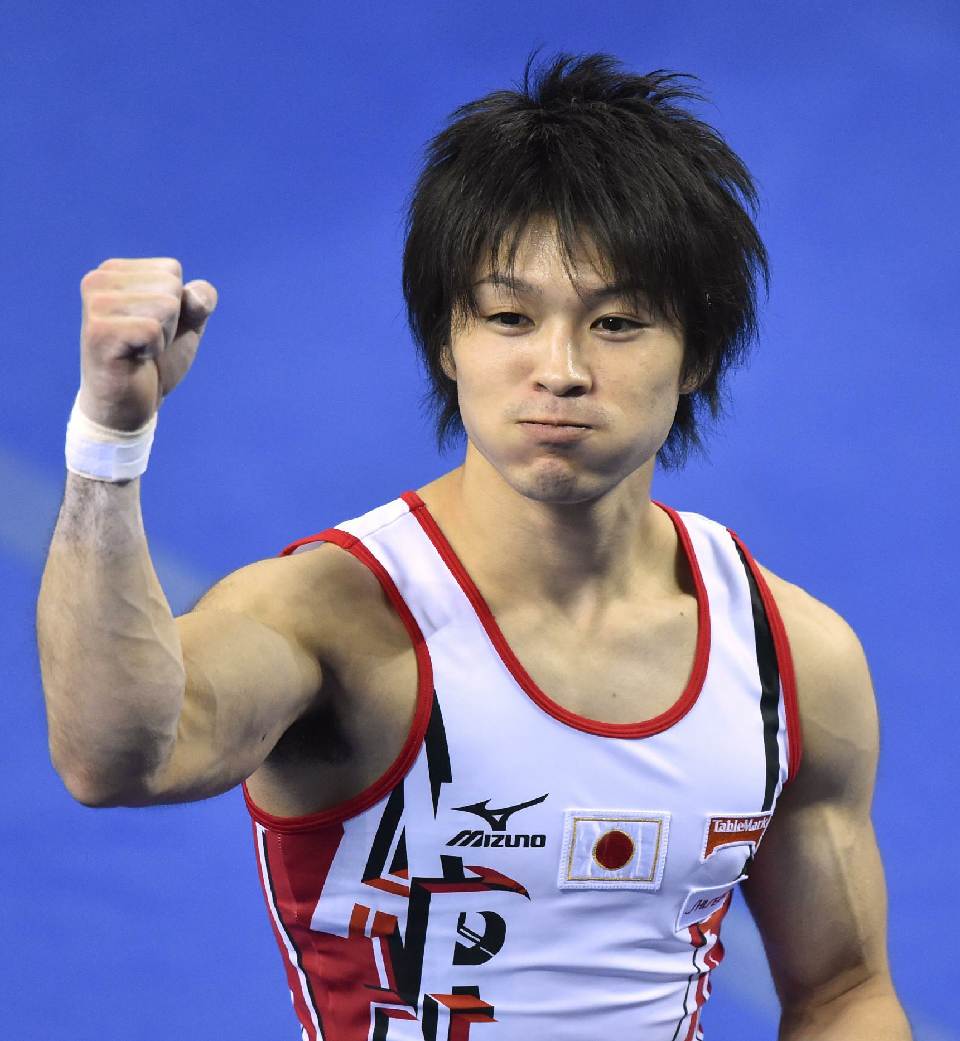
Even after obtaining his third Olympic qualification, Uchimura said, "The Olympics are a different dimension. They won't go the same way as the world championships." Aside from his instinctive qualities, Uchimura also possesses an inquisitive mind to master the sport of gymnastics since he is more familiar with the struggles and hardships in gymnastics more than anyone else. Due to his amazing qualities, no one can tell if there is a limit on how far the “king of gymnastics” can go.

To get more informative posts and news related to the sport of gymnastics, you should like and subscribe to our official Facebook Page. Learn gymnastics for kids with us, enroll now at Bianka Panova Sport and Art Academy and obtain the highest quality of training and education.

Wednesday, November 4, 2015

World Gymnastics Championships filled with Record Breaking Events

Glasgow was filled with record-breaking events as Max Whitlock writes a new chapter in Britain’s sports history after obtaining the world title in the pommel horse finals, making him the first-ever British male athlete to win gold at a World Gymnastics Championships, while four female gymnasts shared the top of the podium after tying on the uneven bars finals.

Fan Yilin, Dario Spiridonova, Madison Kocian and Viktoria Komova finished their uneven bars routine with surprisingly same scores (15.366), resulting in an unexpected “four gold medalists” in the women’s individual apparatus finals.
That unprecedented event brought surprise and amusement to the audience and the four champions, who shared the crowded space at the peak of the medal podium, leaving the two bottom spaces empty.

The medal awarding ceremony was also prolonged as there were three national anthems (Russia, China, and USA) being played. The organizers also had to skip the flag raising ceremony since they can’t fit three national flags on one horizontal pole.

American gymnast Kocian depicted the incident as “super crazy”, while Chinese gymnast Fan Yilin said it was “hilarious”. Russia’s Spiridonova said: “Wow! I’ve never seen anything like this. I didn’t think anything like this would even be possible. It’s great that we are in this together and we will share the victory.”

Her teammate Komova added: "It was hard to deal with the nerves after they started to announce the results. I am personally shocked. It's the first time the judges had such a hard time deciding who the champion was."

NARROW MARGIN


Meanwhile, in the men’s apparatus finals, Whitlock has managed to surpass his compatriot’s score on the pommel horse event by a very tight margin. 

Smith executed a clean routine on the pommel horse to sit on the top of the scoreboard with a score of 16.033 until Whitlock, the last pommel horse competitor, outshone Smith’s performance to finish with a score of 16.133, just a tenth-of-a-point ahead of his compatriot’s score.
The British duo gazed on the giant scoreboard while waiting for Whitlock’s score, and when the score of 16.133 flashed up on the giant screen, Smith quickly grabbed their national flag to begin a double celebration.

"I had dreamed of this moment but never felt I would get emotional," said Whitlock, who also obtained a silver medal in the floor event finals behind Japanese superstar Kenzo Shirai.

"I can't believe it. I trained in the gym thousands and thousands of routines building up to this moment, so when you go clean like I did today, you can't express what you feel. I'm over the moon. It's been an amazing journey."

SHIRAI SHINES


On the men’s floor exercise finals, Japanese Kenzo Shirai executed a routine filled with daring and high-flying acrobatics and ending it with a quadruple twisting somersault, earning him a second world title in 3 years.

A slight mistake on his third tumbling pass was not enough for Shirai to flinch as the Japanese floor exercise supremo was the only competitor to surpass the 16-point barrier after finishing with a score of 16.233.
"As I experienced defeat last year, I know the importance to keep improving. This time I was able to surprise everyone with my difficulty," he said.

Russian gymnast Maria Paseka outclassed most sought-after athlete Simone Biles and the vault defending champion Hong Un-jong with two soaring leaps to obtain the vault world title.

Paseka hit her landing on both of her vaults, an Amanar and a Cheng, to finish with an average total of 15.666. Korea’s Hong Un-jong took the silver medal while American superstar Biles earned bronze.

Paseka’s gold finish sparked a gold rush for Russia, which started the second-to-the-last day of Championships with none but ended the competition with three gold medals, thanks to Paseka, Komova and Spiridonova.

Meanwhile, Greek gymnast Elftherious Petrounias displayed a jaw dropping ring performance to secure the rings world title ahead of Chinese You Hao and 2014 rings defending champion Liu Yang.

Learn gymnastics for kids with us. Let us help you fulfill your child’s dream of being a top-class athlete by enrolling at Bianka Panova Sport and Art Academy. With our head coach’s extensive experience in the field, fun and attractive training environment, and comprehensive training programs, we can ensure that your child will receive the highest quality of education.

Like our official Facebook Page to follow the latest news and information related to the sport of ballet and gymnastics!

Thursday, October 22, 2015

Kohei Uchimura: A Japanese Gymnastics Legend

Those who had the opportunity of reaching the podium with Kohei Uchimura depicts him as a remarkable artistic gymnast. “King Kohei”, “The Bolt of Gymnastics”, “Superman”, or in the most positive sense – a “monster” are only some of the titles that are given to this Japanese gymnastics legend. 

Given that he’s a five-time consecutive World all-around champion, this 26-year-old Japanese gymnast can be considered as the greatest male gymnast  of all time.
Aside from his dominance in the World All-around competitions which earned him a spot in the Guiness Book of World Records, Uchimura is captivating for his unending search for perfection, the Holy Grail of Gymnastics. If some in this generation have chosen to perform an increased level of difficulty in exchange of a good execution, Uchimura returns Men’s Artistic Gymnastics to all its nobility.

This search for perfection started since he was still a child. At the age of 3, he learned his first gymnastics skills with the help of his father, Kazuhisa, a former artistic gymnast. His father trained him at his own gymnastics club in Nagasaki. When he was 15 years old, Uchimura travelled to Tokyo to continue his training together with his idol Naoya Tsukahara, a key member of the gold-medal winning Japanese men’s artistic team at the 2004 Summer Olympics. In the year 2007, while still a teenager, Uchimera joined the Japan’s National Team, where he instantly became famous for his astonishing feats.

At the 2008 Summer Olympics, Uchimura was the youngest member of the Japanese Men’s team, but that didn’t stop him from being one of the top performers. Despite the error that Uchimura commited while dismounting at the Pommel horse in the individual all-around final, he still managed to finish with a silver medal to go along with another silver medal in the Olympic team event.
It was in the following year that Uchimura began showing his extraordinary superiority in the sport, after finishing as a World Champion in the 2009 World Gymnastics Championships in London. He finished 2.5 points ahead of the second placer, the same score margin that separated 2nd from the 8th place.

Despite the lack of height, standing only 5 feet 3 inches, that didn’t stop this legendary gymnast from dominating the sport. Not even an injury has managed to hinder his path. At the 2010 World Gymnastics Championships in Rotterdam, despite having a shoulder program, he still managed to defend his World All-around title along with three additional medals.

One year later, he took part in the 2011 World Championships in Tokyo despite experiencing a pain in his calf, but was such a “machine” that he still managed to finish 3 points ahead of the second placer, the same margin that separated 2nd from the 14th place. After winning his third World all-around gold medal, Uchimura earned a standing ovation from the audience that lasted for two minutes upon the completion of his final routine “I thought it was an earthquake. I’ve never received such applause,” he said.
After such a winning streak, getting a gold at the 2012 Summer Olympics was not a surprise anymore. On his way to Rio, the Japanese gymnastics legend displayed no sign of struggle in the 2013 and 2014 World Championships, obtaining another two World titles with little to no difficulty.

However, despite having an impressive collection of World (a total of 16 medals, including 7 gold) and Olympic Medals (five, including 1 gold and 4 silver), there is still one dream that the Olympic champion has yet to fulfill, to win a gold medal with his team at one of the great international competitions. Since 2008, the Chinese team has always been ahead of the Japan at the World Championships and Olympic Games.
Perhaps the Japanese team will eventually end up as gold medalists one of these years, fulfilling Uchimura’s ultimate dream. As of now, “King Kohei” plans to extend his gymnastics adventure until 2020, when Japan will host the Olympics for the first time since 1964.

Level up your child’s gymnastics for kids training by choosing the right kind of school for your kid. Enroll at Bianka Panova Sport and Art Academy and let us provide your child with the proper training and education in order to unlock your child’s full potential. Subscribe to our social media websites to receive the latest updates regarding the world of ballet and gymnastics! :D

Friday, September 25, 2015

Does Training Through Pain Send Wrong Message To Kids?

In a physically-demanding sport like gymnastics, suffering from injuries, whether it’s a mild or a serious one, is just a common occurrence for the athletes. Usually, if we are injured or experiencing an unusual kind of pain, we do stop our normal activities and rest so that our bodies can have time to recover. However, this is not the case for the professional athletes.


For the elite gymnasts, performing even amidst of pain is just a normal part of their athletic journey. Most of them continue their training and even participate in competitions while suffering from damaged or dislocated bones, torn muscles and other kinds of injuries. Experts are wondering how these things affect the mentality of the young athletes.
There has been a huge growth in the number of gymnastics participants in the U.S. ever since the American gymnastics team Fierce Five made their way to the podium in the 2012 Summer Olympics. According to the Sporting Goods Manufacturers Association, there has been an 18 percent increase in the number of participants of the sport since 2009. However, parents should be aware of the risks that are associated in a sport that requires young children, before they even reach the age of ten, to perform 10-15 hours of training per week in the entire year.
“It's an amazing sport but it's also a demanding one," the owner of NYC Elite, Tina Ferriola stated. “Just like any other competitive sport, it can be injury-prone” she continued.

Risk of injury


According to a report that was published by the Center for Injury Research and Policy in Columbus, out of 3 million children participating in gymnastics, around 25,000 of them are treated in U.S emergency rooms every year due to injuries related to their involvement in the sport. That’s comparable with the injury rates from sports that require physical contact such as lacrosse and hockey.
Shoulder pain, wrist injury, and other pain associated with the upper body are the most commonly reported gymnastics-related injuries. Lower body injuries such as ankle, knee and spine injuries are also common. Some of these injuries are an unavoidable result of overuse. Some of them are caused by improper landing and other mistakes while performing a routine or a stunt.
Around 40 percent of these injuries happen inside the gym, and another 40 percent takes place during the school recreation programs. However, for emerging gymnasts that are aged 6-11 years old, sending them to a gymnastics school proved to be more beneficial in preventing further harm – as kids in this age group is more likely to be injured at home while they’re playing around and jumping off tables and bouncing on couches without the proper matting, equipment and supervision.

"When gymnastics is done properly, it looks daring but the athletes have actually been taught the basics of how to move their bodies safely," said Randy Nebel, a gymnastics coach at NYC Elite "A program where there's proper spotting and coaching undoubtedly saves a lot of kids from getting hurt."

The president of the National Athletic Trainers Association, Jim Thornton agreed, and he added that it is also critical for coaches to give more emphasis on balance and flexibility training, and give importance on overall conditioning."They might be sore after a workout and that's OK but they should never workout with pain that doesn't resolve within a few days," he stated.
He also said that parents should keep an eye out for coaches who are pushing kids too hard. "If a coach is telling your child to ignore the pain and keep going, that's a red flag," he said.

Pushy Parents


However, there are times where it’s the parents’ strong desire for success that leads their child at risk. Believing that their child might be the next gymnastics sensation, they encourage their young children to push themselves beyond their capabilities.

Rhonda Dixon, the owner of Excel Gymnastics, remembered a parent that wanted her child to move up the competitive ranks although her coaches think that the child wasn’t ready yet. "She had a terrible season. She was scared of the skills and cried a lot during practices. Meanwhile her mom was on the sidelines asking her why she couldn't do what the other girls were doing." Thankfully, not all parents are like that. However, when parents get out of hand, the Excel Gymnastics owner said that it’s the responsibility of the coach to remind these parents that safety is more important especially for kids that are that young.

As for the message that the elite gymnasts sends to emerging gymnasts, believing that training while injured is not only okay – its expected – they are not seeing the whole picture, and therefore must erase this kind of mindset.According to Nastia Lukin, an Olympic individual all-around champion, even the elite gymnasts take a break if the injury is serious enough and might cause long term damage.

"I've dealt with aches and pains and you certainly put them out of your mind during competition if they're not severe but it's so important to communicate to your coaches, your parents and your medical staff," she said. "If it's spotted early it can be taken care of. If it's really bad, you don't want to make it worse."

Get the most recent news and updates in connection with gymnastics by liking and visiting the Official Facebook Page of Bianka Panova Academy. Looking for a school that offers various kinds of classes and gymnastics for kids? Then you’re on the right path, Bianka Panova Academy is definitely the school for you!